Developing a Book Idea: A Guide for Purpose-Driven Writers

What if the most profound barrier to your manuscript isn't a lack of talent, but a lack of emotional spaciousness? For many purpose-driven writers, the initial spark of inspiration often brings a heavy weight of responsibility. You might feel overwhelmed by the sheer scope of your message or worry that you aren't "expert" enough to hold the space. It’s common to fear that the process will be draining rather than restorative, particularly whilst revisiting sensitive themes. Knowing how to develop a book idea is about more than just outlining chapters; it's about aligning your creative vision with your personal values.
You deserve a writing practice that feels like a safe harbour rather than a source of stress. In this guide, we'll explore a grounded, empathetic framework designed to help you turn that flicker of an idea into a structured, meaningful book. We'll move beyond rigid industry standards to find a path that protects your creative well-being. By the end, you'll have a clear sequence to follow that ensures your manuscript remains an authentic reflection of your intent, allowing your voice to emerge with quiet confidence.
Key Takeaways
- Learn how to use an "inside-out" approach to ensure your book idea remains deeply aligned with your personal integrity and mission.
- Discover a grounded, step-by-step framework for how to develop a book idea that transforms a flicker of inspiration into a robust and logical structure.
- Understand why viewing your manuscript as a supportive container can protect your creative well-being and prevent you from feeling emotionally drained.
- Explore the vital role of author mentoring and developmental editing in refining your vision whilst preserving your unique, authentic voice.
- Identify ways to cultivate a sustainable and restorative writing practice that prioritises your well-being over the demands of high-pressure output.
The Alchemy of a Book Idea: Understanding Development
Many writers mistake a passing thought for a finished vision. Real book development is the bridge between that initial flicker of inspiration and a robust, resilient manuscript. It is a process of slowing down. Whilst others might rush to fill pages, understanding how to develop a book idea requires a profound commitment to intentionality. This foundation ensures your work resonates with readers on a psychological level, rather than just offering surface-level entertainment. It transforms a simple premise into a contribution that carries weight and integrity.
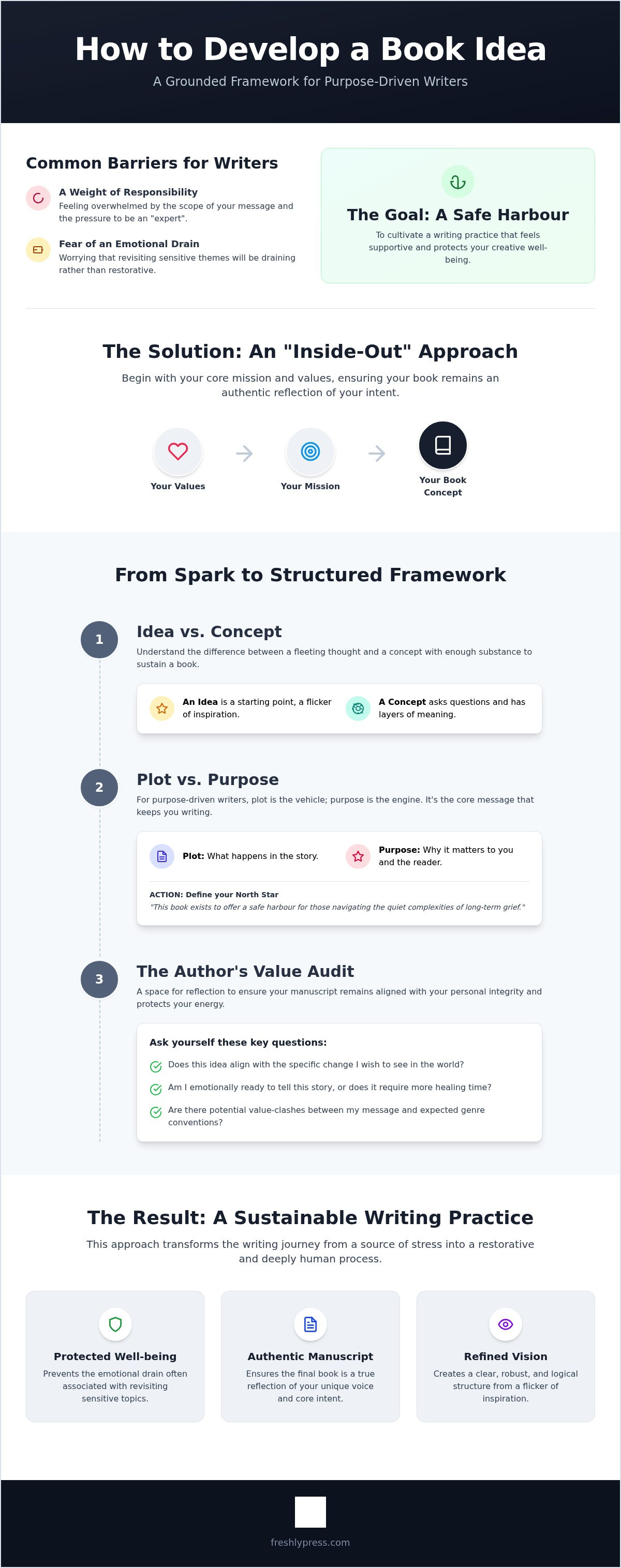
There's a significant difference between having an idea and cultivating a concept. An idea is a starting point; a concept is a living entity with depth. You'll recognise when an idea has enough substance to sustain a full-length work when it begins to ask questions you can't answer in a single sitting. It should feel like a conversation that evolves as you engage with it. If the thought keeps returning to you with new layers of meaning, it likely has the marrow required for a book-length journey.
The Difference Between Plot and Purpose
In traditional writing circles, the focus often remains on the mechanics of the elements of fiction writing, such as what happens next and who the characters are. For purpose-driven writers, however, plot is merely the vehicle. Purpose is the engine. Plot is what happens; purpose is why it matters to both you and your reader. To find your core truth, look for the underlying message that keeps you returning to the page even when the writing feels difficult.
Try to define your book's primary purpose in a single sentence without mentioning a single plot point. For example: "This book exists to offer a safe harbour for those navigating the quiet complexities of long-term grief." This clarity acts as a North Star during the long months of drafting.
Moving Beyond the 'Elevator Pitch'
The publishing industry often demands a polished elevator pitch before an idea is even fully formed. This can feel incredibly restrictive for sensitive thinkers. It forces you to categorise your work into a specific genre or a "hook" before you've explored its nuances. Give yourself the gift of spaciousness instead. Let the idea breathe in the early days. Curiosity is your most valuable tool during these stages. Instead of deciding exactly what the book is, ask what it wants to become. This restorative approach allows the manuscript to grow in alignment with your values, ensuring the process remains sustainable and deeply human.
Aligning Your Concept with Your Personal Values
A book is more than a collection of chapters; it's a reflection of the author's internal landscape. For purpose-driven writers, the creative process cannot be separated from personal integrity. When you're exploring how to develop a book idea, the most sustainable path begins with an "Inside-Out" approach. This means starting with your mission and values rather than looking at what is currently trending on bestseller lists. If your concept doesn't resonate with your core truth, you'll likely find the writing process draining rather than restorative.
The Value Audit for Authors
Before committing to a manuscript, it's helpful to perform a value audit. This isn't a mechanical checklist, but a space for reflection. It allows you to ensure that your energy remains high throughout the long journey of authorship. Ask yourself:
- Does this idea align with the specific change I wish to see in the world?
- Am I emotionally ready to tell this story, or does it require more healing time?
- Are there potential value-clashes between my message and the expected genre conventions?
Identifying these points early prevents the kind of deep-seated writer's block that stems from internal misalignment. It ensures that your book remains a safe harbour for your thoughts, even during the challenging middle chapters. This clarity is essential for maintaining your mental and emotional well-being whilst you write.
Finding Your Authentic Voice Amongst the Noise
To develop your book's central idea, you must learn to listen to your own voice amongst the noise of industry trends. Your voice provides the unique colour and texture of your work. It's the element that answers the "Why Me?" question. You don't need to be a traditional expert with decades of academic credentials to have authority. Your authority comes from your lived experience and the grounded empathy you bring to your subject.
This authenticity is what serves your audience best. Readers aren't looking for a perfect, distant authority; they're looking for a guide who understands their journey. If you feel stuck trying to balance your truth with audience expectations, bespoke author mentoring can help you find that equilibrium. By refining your vision whilst maintaining your authentic voice, you create a work that is both professional and deeply human.
Moving from a Spark to a Structured Framework
Once you've aligned your concept with your internal values, the next stage of how to develop a book idea involves creating a structure that holds your message without stifling it. Many writers fear that an outline will kill the magic of their initial spark. However, if we view structure as a supportive container rather than a restrictive cage, it becomes a tool for psychological safety. It provides the boundaries needed to explore complex or sensitive themes without feeling lost. This framework acts as a steady hand on your shoulder, reminding you of your path whilst allowing room for the scenic detours that make a book feel alive.
Identifying the pillars of your manuscript is essential. These are the non-negotiable concepts or turning points that support your central thesis. Think of them as the steady beams of a house. Whilst the interior decor might change as you write, these pillars remain firm. This leads to the "Living Outline" method, where you maintain a clear direction but remain open to new ideas for writing a book that emerge during the drafting process. This approach honours the evolution of your thoughts, ensuring the final manuscript feels authentic rather than manufactured.
Framework vs. Rigid Outline: Finding the Balance
A flexible framework allows you to organise your thoughts without the clinical pressure of traditional plotting. It prioritises the rhythm of your message over rigid word counts or chapter quotas. Developmental editing often begins here, helping you refine these milestones before you commit thousands of words to the page.
| Feature | Rigid Outline | Flexible Framework |
|---|---|---|
| Primary Goal | Total control over output | Support for the creative process |
| Emotional Tone | Clinical and high-pressure | Grounded and restorative |
| Creative Space | Restrictive and fixed | Spacious and evolving |
Mapping the Reader's Journey
Every meaningful book is a journey of transformation. To develop your idea effectively, you must consider where your reader starts and where they end emotionally. Each section should build upon the previous one, creating a logical flow that feels like a deepening conversation. You aren't just giving them information; you're guiding them through a shift in perspective. Try this practical exercise to clarify your book's promise in three stages:
- The Initial State: What is the core pain, question, or curiosity the reader carries at the start?
- The Turning Point: What is the central insight or experience that changes their view?
- The Restored State: What sense of peace, clarity, or empowerment do they possess by the final page?
Cultivating a Sustainable Writing Practice
Traditional publishing advice often glorifies the "hustle," suggesting that true authors must produce thousands of words daily regardless of their emotional state. For those exploring how to develop a book idea with depth and integrity, this approach is often counterproductive. A restorative creative process acknowledges that your well-being is the foundation of your work. If the writer is depleted, the manuscript will lack the resonance and vitality required to truly connect with a reader. Developing a book is a marathon of the heart, not a sprint for the finish line.
Integrating bibliotherapy into your routine can provide essential fuel during this stage. By engaging with texts that mirror your themes or offer psychological comfort, you allow your subconscious to process the complexities of your own work. This reflective practice ensures that your idea continues to grow even when you aren't actively typing. Setting clear boundaries around your writing time is equally vital. It prevents the process from bleeding into your rest periods, ensuring that your creativity remains a source of joy rather than a cause of burnout.
The Trauma-Informed Creative Process
Many purpose-driven books touch on sensitive or painful personal histories. Recognising when an idea triggers these feelings is a crucial part of the development journey. You must create a "safe harbour" for your practice, which might mean limiting writing sessions or working with a supportive partner. Pace matters significantly more than speed. If you're dealing with deep, purposeful topics, allow yourself the grace to move slowly. This intentionality protects you from re-traumatisation and ensures your voice remains steady and clear.
Mindful Reflection as a Development Tool
Quiet observation is often more productive than forced drafting. Using meditation to "listen" to your book idea allows the structure to emerge naturally. It's vital to value "unproductive" time, such as walking in nature or sitting in silence. These moments aren't gaps in your schedule; they're the spaces where your most profound insights take root. Learn to distinguish between resistance, which is a fear-based hesitation, and the genuine need for a restorative break. One requires a gentle nudge, whilst the other demands complete rest.
If you find that the emotional weight of your manuscript is becoming difficult to carry alone, professional support can make a significant difference. You might consider exploring bespoke book coaching to help you navigate these sensitive waters with expert guidance and empathy.
Refining the Vision: The Role of Author Mentoring
Refining a creative vision is a delicate, iterative act. Whilst the early stages of how to develop a book idea are often solitary, bringing in a professional mentor provides a necessary mirror for your thoughts. A book coach differs significantly from a traditional editor. An editor typically focuses on the mechanics of a completed manuscript; a coach focuses on the writer and the conceptual foundation from the very beginning. This partnership offers a steady hand during the long, often unpredictable journey of authorship, ensuring that your original spark isn't lost in the complexities of the process.
Mentoring provides the accountability and encouragement needed for the long haul. It’s easy to feel inspired in the first week, but maintaining that depth over months of development requires a different kind of energy. A professional advocate helps you stay true to your mission, reminding you of your "why" when the path becomes obscured. This shift marks the transition from wondering how to develop a book idea in isolation to refining it through professional, ethical dialogue. It ensures your manuscript is built on a foundation of integrity rather than just a desire for completion.
The Value of One-to-One Book Coaching
Mentoring acts as a safe harbour during the "messy middle" of idea development. This is the stage where abstract themes can feel tangled or overwhelming. For sensitive writers and purpose-driven entrepreneurs, having an ethical advocate ensures that the manuscript doesn't lose its soul in the pursuit of traditional genre tropes. Coaching helps you navigate these nuances by providing a structured yet gentle space for exploration. It allows you to test your pillars and refine your reader's journey with the support of someone who understands the psychological weight of the creative process.
Choosing the Right Support for Your Journey
When selecting a mentor, look for a partner who prioritises your well-being and the integrity of your message over sheer word-count output. A trauma-informed approach is essential for those writing about sensitive personal histories or profound social changes. This ensures the coaching process remains restorative rather than demanding, respecting your pace and your boundaries. The right support feels like a quiet authority that empowers your own voice rather than overriding it. Discover how one-to-one book coaching can help you develop your idea with intentionality.
Embracing Your Creative Journey with Integrity
Transforming a flicker of inspiration into a meaningful manuscript is a sacred process that requires both patience and precision. You've explored how to align your concept with your deepest values, creating a supportive framework that allows your voice to emerge without the pressure of traditional hustle culture. Understanding how to develop a book idea is ultimately a process of deep listening; it's about ensuring your message remains authentic whilst protecting your own emotional well-being.
By prioritising a sustainable practice and seeking the right external perspective, you turn a daunting task into a restorative journey. If you're ready to move from a spark to a structured vision, professional support can provide the safe harbour you need. Through a trauma-informed coaching approach and bespoke developmental editing, we help you navigate the complexities of your story with care. We also offer integrated bibliotherapy to support your creative well-being at every stage. Refine your book idea with a compassionate book coach and begin the transition from inspiration to a robust, purposeful manuscript. Your story carries weight, and it deserves to be told with both depth and gentleness.
Frequently Asked Questions
How do I know if my book idea is actually worth writing about?
Knowing how to develop a book idea that carries weight starts with auditing if the concept resonates with your core truth and provides a meaningful shift for your audience. Rather than chasing market trends, consider if the idea feels sustainable to explore over several months. If the thought keeps returning with new layers of depth, it likely has the substance needed for a full manuscript. A mentor can help you verify this alignment early on.
Can I develop a book idea whilst working a full-time job?
You can certainly develop your book whilst maintaining a full-time career by prioritising a sustainable pace over rapid output. The key is to view your writing as a restorative practice rather than another chore on your to-do list. By dedicating small, intentional pockets of time to your framework, you can make steady progress without risking burnout. This methodical approach often leads to deeper, more considered work that honours your creative well-being.
What is the difference between developmental editing and book coaching?
Book coaching focuses on the writer and the creative process from the earliest stages, providing emotional support and strategic guidance. Developmental editing is more manuscript-focused, usually occurring once a draft or detailed concept exists to refine the structure and flow. At Freshly Press, we often blend these approaches to ensure your authentic voice remains central whilst building a professional framework. Coaching acts as a safe harbour, whereas editing polishes the final vision.
How do I keep my book idea from becoming too overwhelming?
To prevent overwhelm, break your concept down into foundational pillars rather than trying to see the entire book at once. Focus on the transformation you want your reader to experience in three distinct stages: the initial pain, the turning point, and the restored state. By creating a flexible framework, you give yourself a supportive container that provides direction without the pressure of a rigid mountain. This spacious approach allows your idea to breathe naturally.
Is it possible to write a book about trauma without it being re-traumatising?
It is possible to write about sensitive history by employing trauma-informed practices that prioritise your psychological safety. This involves setting firm boundaries for your writing sessions and recognising when you need to step back. Working with a mentor who understands these complexities can help you navigate the "messy middle" without feeling drained. The goal is to ensure the process of how to develop a book idea remains restorative and healing for you throughout the journey.
How long does it typically take to develop a book idea into a framework?
The timeline for turning a spark into a framework typically spans between four to twelve weeks of intentional reflection. This period allows you to test your ideas and ensure they align with your mission before you begin drafting. Whilst some might rush this phase, taking a methodical approach ensures your manuscript has a resilient foundation. This steady pace prevents future structural issues and helps you maintain a sense of internal alignment throughout the project.
Do I need to have my whole book planned out before I start writing?
You don't need every chapter mapped out, but having a clear direction and established pillars is highly beneficial. A "Living Outline" allows for evolution whilst ensuring you don't lose your way during the drafting process. This balance provides enough structure to feel safe, yet enough spaciousness to discover new insights as you write. It’s about knowing the destination and the major milestones, whilst remaining open to the scenic detours that add depth.
How can bibliotherapy help me in the early stages of book development?
Bibliotherapy supports you by using curated reading and reflection to explore the themes of your own work from a safe distance. In the early stages, it helps you identify the emotional core of your message and see how others have navigated similar narratives. This practice acts as a bridge between your internal experiences and the page. It fosters a deeper connection to your subject matter whilst nurturing your mental and emotional well-being throughout the process.
